
Call Now For A Case Evaluation
Call Now For A Case Evaluation
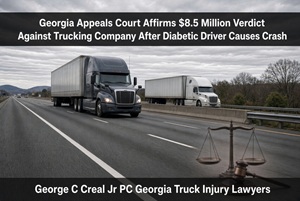 On September 9, 2026, the Georgia Court of Appeals issued an important decision for victims of commercial truck accidents and guidance on Governor Kemp’s controversial Tort Reform agenda. In Transcontinental Carriers, Inc. et al. v. Bennett, No. A26A1643, the court unanimously affirmed an $8.5 million jury verdict for Lewis Bennett, a truck driver seriously injured when another tractor-trailer swerved into his lane.
The case, decided by Presiding Judge Barnes and Judges Markle and Hodges, offers valuable guidance on employer responsibility, evidence in trifurcated trials, and attorney-fee awards under Georgia law.
On July 1, 2020, James J. Evans was driving a Mack tractor-trailer for Transcontinental Carriers on Interstate 75 in Houston County. Evans, who had Type 1 diabetes since 1995, had not taken his required insulin that day. He experienced diabetic shock and failed to maintain his lane. His truck moved from the left lane into the right lane occupied by Lewis Bennett’s loaded tractor-trailer. Bennett was forced off the roadway and into a guardrail. The sudden shift of Bennett’s 43,000-pound load caused severe whiplash and spinal trauma.
Evans continued driving erratically for several miles until police stopped him. Officers found a diabetes treatment kit in the cab and confirmed he had not taken insulin. Evans later died in 2021. Bennett required two spinal surgeries, suffers from a permanent spinal cord injury and bladder dysfunction, and now uses a four-point walker.
A Spalding County jury awarded Bennett $7 million in compensatory damages plus $1.5 million in attorney fees under OCGA § 13-6-11, for a total of $8.5 million. This verdict came after Georgia’s 2025 tort-reform changes and was one of the first large personal-injury awards under the new framework.
The trucking company and its insurer appealed on several grounds. The Court of Appeals rejected each argument:
These holdings reinforce that trucking companies cannot hide behind a driver’s medical emergency when they knew or should have known of serious compliance problems.
Commercial trucks can weigh tens of thousands of pounds and up to 80,000 pounds or 40 tons. When a driver with a known, poorly managed medical condition is allowed to operate one, the results can be catastrophic. This opinion confirms several practical points:
If you or a loved one has been hurt in a collision with a commercial truck, time is limited. Georgia generally gives injured people two years from the date of the crash to file a lawsuit. Evidence such as electronic logging-device data, dash-cam footage, and driver qualification files can disappear quickly.
At George C. Creal Jr., P.C., Trial Lawyers, we represent people injured by negligent drivers and the companies that employ them. Our firm has decades of courtroom experience in personal-injury and trial work across Metro Atlanta and the State of Georgia.
Call us today at 770-961-5511 or visit www.georgialawyer.com for a free, confidential consultation. We work on a contingency fee basis, you pay nothing unless we recover compensation for you.
Offices in Forest Park and Downtown Atlanta. Serving clients throughout Georgia.
This article is for informational purposes only and does not constitute legal advice. Every case is different. Consult a licensed Georgia attorney about your specific situation.

George Creal is a trial lawyer who has been practicing law
in the Metro-Atlanta area for over 27 years. George brings
a broad range of experience to the courtroom. Read More