
Call Now For A Case Evaluation
Call Now For A Case Evaluation
 As a Georgia trial lawyer handling personal injury and property-damage cases across Metro Atlanta, I watch the Georgia Supreme Court closely when it draws the line between government power and private rights. On September 9, 2026, the Court did exactly that.
In Blue 42 Organics, LLC v. Georgia Department of Public Safety, No. S25G1439 (Ga. Sept. 9, 2026), Chief Justice Nels Peterson wrote for the Court and reversed a dismissal that would have let the State walk away from crop damage caused by a low flying drug interdiction operation. The message is simple: calling something an exercise of “police power” does not automatically wipe out the duty to pay just compensation.
All justices joined the opinion except Justice Land, who was disqualified.
Blue 42 Organics is a licensed hemp grower. Its Dahlonega farm was registered with the Georgia Department of Agriculture and the USDA, including GPS coordinates of the crop.
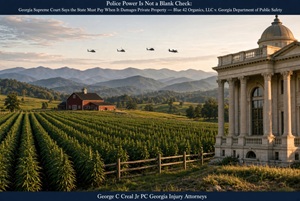
On July 21, 2021, DPS through the Governor’s Drug Suppression Task Force ran a drug suppression operation in the area. Three helicopters and a fixed wing aircraft flew so low over the farm that they destroyed two rows of hemp, alleged at about $37,000, and harassed cattle on leased grazing land.
Blue 42 sued for inverse condemnation under the Georgia Constitution and for attorney fees. It did not claim the officers committed a personal tort in the usual sense. It claimed the State damaged private property for a public purpose and owed payment.
The trial court dismissed. The Court of Appeals affirmed. Both bought DPS’s theory that sovereign immunity and the police power barred the claim no matter what the complaint alleged.
The Supreme Court granted certiorari and disagreed.
Georgia’s Just Compensation Clause is not optional. Article I, Section III, Paragraph I(a) of the 1983 Constitution says:
Private property shall not be taken or damaged for public purposes without just and adequate compensation being first paid.
That clause has been in Georgia constitutions in one form or another since 1861. It is the reason an inverse condemnation suit can proceed against the State even when ordinary tort claims would be blocked by sovereign immunity.
“Police power” is a real and broad power. It covers public health, safety, morality, and welfare – far more than a traffic stop or a raid. But it is still subordinate to the Constitution. If the rule were otherwise, the State could destroy a farm, a shop, or a car, label the act “police power,” and never write a check.
Chief Justice Peterson put it this way: the Constitution’s promise to protect private property would be an empty one if the State could avoid paying just compensation merely by invoking the police power.
The Court did not say every police operation requires a payout. History recognizes two situations in which destruction of private property may not require compensation:
Those exceptions are narrow. They do not cover routine law enforcement activity just because officers were on the job.
On the face of Blue 42’s complaint, the hemp crop was legal and registered. Nothing pleaded an emergency or a nuisance. Dismissal on a categorical police power theory was therefore error.
The Court overruled or cabined older language that treated “police power” as a complete escape hatch, including McCoy v. Sanders, 113 Ga. App. 565 (1966), and overbroad statements in Lewis v. DeKalb County, 251 Ga. 100 (1983).
This is important for anyone reading headlines.
The Court did not award Blue 42 $37,000. It did not decide whether this particular flyover was a “public purpose,” whether DPS can later prove nuisance or emergency, or whether some other defense will win on a full record. It held only that a motion to dismiss cannot rest on “we were using police power.”
The case goes back for litigation on the merits.
Most people who call my office are not hemp farmers. They are drivers whose cars were wrecked in a chase, homeowners whose property was torn up during a search, or business owners whose inventory was destroyed when the State acted for a public purpose and then refused to pay.
Blue 42 is useful in those fights for three practical reasons:
It is also a reminder that property damage claims against the government are technical. Notice rules, constitutional claims, and ordinary negligence claims are not interchangeable. Missing the right theory can end a good case before it starts.
If DPS, a county, a city, or another agency destroyed or damaged your vehicle, home, crops, or business property, do not assume you have no claim because “it was the police.” You also should not assume you automatically win. The facts matter: what was damaged, why the government was there, whether there was a genuine emergency, and whether the property was itself a nuisance.
Document the damage. Preserve photos, video, GPS, leases, and crop or inventory records. Get the incident report. Talk to a lawyer before you give a recorded statement or sign a release.
George C. Creal, Jr., P.C. represents people in personal injury, property damage, criminal defense, and DUI cases throughout Georgia, including Gwinnett, Fulton, DeKalb, Clayton, Cobb, and Hall Counties.
Call or text: (770) 961-5511
Visit: www.georgialawyer.com
Forest Park: 720 Main Street, Forest Park, GA 30297
Atlanta: 480 John Wesley Dobbs Ave. NE, Unit 190, Atlanta, GA 30312
This post is for general information about a published Georgia Supreme Court decision. It is not legal advice and does not create an attorney client relationship. Every case depends on its own facts.
Case cite: Blue 42 Organics, LLC v. Ga. Dep’t of Pub. Safety, No. S25G1439 (Ga. Sept. 9, 2026) (Peterson, C.J.), reversing Blue 42 Organics, LLC v. Dep’t of Pub. Safety, 376 Ga. App. 135 (2025).

George Creal is a trial lawyer who has been practicing law
in the Metro-Atlanta area for over 27 years. George brings
a broad range of experience to the courtroom. Read More