
Call Now For A Case Evaluation
Call Now For A Case Evaluation
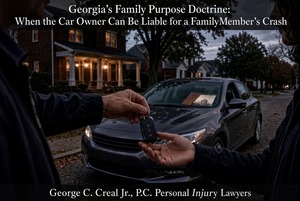 A wreck caused by a teen, a spouse, or another household driver often looks like a one defendant case. In Georgia, it frequently is not. If someone in the home furnished that vehicle for the family’s use, the injured person may also have a claim against the owner under the family purpose doctrine.
The doctrine exists for a practical reason. The person behind the wheel may have few assets and thin coverage. The person who put the car in the driveway for household convenience often has the insurance and the assets that make a full recovery possible.
The family purpose doctrine is vicarious liability. The owner is not accused of running the red light. The owner is treated as if providing a car for the family’s comfort and convenience is the owner’s “business,” and the family driver is treated as the owner’s agent while using the car for that purpose.
Georgia built the rule on O.C.G.A. § 51-2-2, which provides that every person “shall be liable for torts committed by his wife, his child, or his servant, by his command or in the prosecution and within the scope of his business,” whether the tort is negligent or intentional.
The Georgia Supreme Court adopted the automobile version of that rule in Griffin v. Russell, 144 Ga. 275, 87 S.E. 10 (1915): if a parent keeps an automobile for the comfort and pleasure of the family and authorizes a child to drive it for that purpose, the owner is liable for the child’s negligence.
The Court later restated the rule in Ferguson v. Gurley, 218 Ga. 276, 279–80, 127 S.E.2d 462 (1962):
Under the family purpose doctrine, one who furnishes an automobile for the pleasure and convenience of his family makes the use of such vehicle for such purpose his affair or business, and is liable for the negligence of a member of the family driving the vehicle for such purpose with his consent, express or implied.
Mere ownership is not enough. Title on the registration, standing alone, does not create liability. See Bailey v. Butler, 199 Ga. App. 753, 754, 406 S.E.2d 97 (1991); Hicks v. Newman, 283 Ga. App. 352, 353, 641 S.E.2d 589 (2007).
The Court of Appeals has treated a family purpose claim as a separate theory of recovery from the driver’s own negligence. Safi-Rafiq v. Balasubramaniam, 298 Ga. App. 274, 276, 679 S.E.2d 822 (2009). That matters for pleading and for the two year limitation period.
Modern decisions use a two-step analysis. See Yim v. Carr, 349 Ga. App. 892, 895–96, 827 S.E.2d 685 (2019); Dashtpeyma v. Wade, 285 Ga. App. 361, 362–63, 646 S.E.2d 335 (2007); Guzman v. Link, 354 Ga. App. 463, 841 S.E.2d 203 (2020).
All four must be present:
Bailey, 199 Ga. App. at 754; Quan v. Johnson, 190 Ga. App. 510, 510, 379 S.E.2d 426 (1989).
Even if those four facts exist, the owner is liable only if they had enough right of authority and control that the law can treat the driver as the owner’s agent. Courts call this the principal factor.
Agency, not ownership, is the test of liability.
Walston v. White, 213 Ga. App. 441, 442, 444 S.E.2d 855 (1994); Murch v. Brown, 166 Ga. App. 538, 539, 304 S.E.2d 750 (1983); Yim, 349 Ga. App. at 896.
“Owner” is broader than the name on the tag. It includes a person who owns the car, controls its use, has a property interest in it, or supplies it. Tolbert v. Murrell, 253 Ga. 566, 568, 322 S.E.2d 487 (1984).
A “provider” is the person who is the principal mover in putting the car in the family member’s hands and who contributes substantially toward that end without expecting reimbursement. Dashtpeyma, 285 Ga. App. at 363.
Georgia reads this category broadly. Pleasure, comfort, and convenience of the family—or of one member of the family—can qualify. Ferguson, 218 Ga. at 279–80; Hubert v. Harpe, 181 Ga. 168, 182 S.E. 167 (1935).
Examples that can qualify:
Permission may be express or implied. Repeated use that the owner does not stop can be acquiescence. Murch, 166 Ga. App. at 538–39. A trip that looks “personal” to the teenager can still be a family purpose if that is why the car was furnished.
There is no presumption that every family that owns a car keeps it as a family purpose vehicle. That fact must be proved. See the annotations to O.C.G.A. § 51-2-2.
| Facts that often support a claim | Facts that often defeat a claim |
|---|---|
| Minor or adult child living at home, driving the household car with permission | Adult child living independently who bought and controls the car |
| Parent pays the note, insurance, and gas and can take the keys | Title in a parent’s name only as a favor, with no real control |
| Spouse driving the family vehicle on ordinary household business | Roommate, friend, or non household relative |
| Same immediate household | College student whose parents co-signed but do not control day to day use |
Yim v. Carr, 349 Ga. App. 892, 827 S.E.2d 685 (2019), is the usual citation for the last point. The parents co-owned the car, co-signed the note, and carried the insurance. That was not enough. The adult daughter lived apart and controlled day to day use, so the parents lacked the required authority.
The doctrine generally does not apply to a stranger who borrowed the car. That case is ordinary permission, negligent entrustment, or insurance coverage not family purpose.
Negligent entrustment is a different claim. It requires proof the owner knew or should have known the driver was incompetent or reckless. Family purpose does not require that showing.
Georgia courts have also refused to let a third party use the doctrine defensively to impute a driver’s negligence to an owner-passenger and wipe out the owner’s own injury or wrongful-death claim. Guzman v. Link, 354 Ga. App. 463, 841 S.E.2d 203 (2020).
Insurers often treat the case as “the teen’s wreck” and evaluate only the driver’s policy. That is incomplete.
A family purpose claim can:
On many household auto policies the owner and resident relatives are already insured. The doctrine still matters when the car is titled to a parent, the driver is underinsured, or the insurer disputes who “supplied” the vehicle.
Most Georgia personal injury and wrongful death claims must be filed within two years. O.C.G.A. § 9-3-33. Waiting while the insurer “looks into it” can cost the claim. Because family purpose can be treated as a distinct theory, it should be investigated and pleaded before that clock runs. Safi-Rafiq, 298 Ga. App. at 276.
If a family car may have been involved, preserve:
Those facts decide summary judgment more often than the police report’s “owner” box. Walston, 213 Ga. App. at 442; Yim, 349 Ga. App. at 896.
Statute
Georgia Supreme Court
Georgia Court of Appeals
Do not assume the only responsible party is the person who was driving. George C. Creal, Jr., P.C. represents people hurt in Georgia auto and truck wrecks and investigates owner liability, insurance coverage, and family purpose facts from the start.
Free case evaluation: (770) 961-5511
Online: www.georgialawyer.com
George C. Creal, Jr., P.C., Trial Lawyers
Forest Park: 720 Main Street, Forest Park, GA 30297
Atlanta: 480 John Wesley Dobbs Ave. NE, Unit 190, Atlanta, GA 30312
This article is for educational purposes only and is not legal advice. George C. Creal, Jr., P.C. is authorized to practice in Georgia. Whether the family purpose doctrine applies depends on the facts of the wreck, the household, and who supplied the car. Deadlines are short. If you were injured, speak with a Georgia personal injury lawyer about your situation.

George Creal is a trial lawyer who has been practicing law
in the Metro-Atlanta area for over 27 years. George brings
a broad range of experience to the courtroom. Read More