
Call Now For A Case Evaluation
Call Now For A Case Evaluation
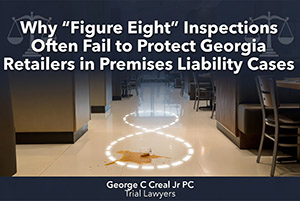 In Georgia premises liability cases, store owners and their insurance companies frequently argue that they had a reasonable inspection program in place, which should defeat a customer’s claim. One common “best practice” cited by retailers is the “figure eight” inspection — employees walking the sales floor in a continuous figure-eight pattern to scan for hazards.
A recent federal court decision out of the Southern District of Georgia shows why this informal approach is often not enough to win summary judgment for the defense.
The “figure eight” method is a loose, informal inspection routine in which employees are trained to constantly move through the store in a looping, figure-eight pattern. The goal is to visually scan the floors and walkways for spills, debris, boxes, or other hazards while they work.
In the recent case of Linda Fabean v. Bath & Body Works, LLC (U.S. District Court, S.D. Georgia, Savannah Division, March 31, 2026), Bath & Body Works described its policy this way:
On its face, this sounds like a proactive safety measure. In reality, Georgia courts have repeatedly held that vague, undocumented “constant scanning” or “walk the store” policies are usually insufficient to defeat a plaintiff’s claim.
On December 11, 2022, during a busy “Candle Day” sale, Linda Fabean tripped and fell in a Bath & Body Works store in Savannah. She felt something wrap around her feet and fell, injuring her knees, hip, and back. After the fall, she discovered a candle crate (the cardboard cartons used to carry candles) had become stuck to her shoe. Candle crates were routinely stored under display tables, but the evidence suggested at least one had protruded into the walkway.
Bath & Body Works moved for summary judgment, arguing it lacked constructive knowledge of the hazard because it had a reasonable inspection program (the figure eight method).
U.S. District Judge R. Stan Baker denied the motion. Here’s why the figure eight policy did not protect the store:
The judge cited several Georgia cases (Benefield v. Tominich, Ingles Markets v. Martin, and KMart Corp. v. Jackson) where similar vague “constantly walk the store” policies were ruled insufficient as a matter of law.
Because the store could not prove it had both a reasonable inspection program and that the program was followed, the court could not rule as a matter of law that Bath & Body Works lacked constructive knowledge of the hazard.
Under Georgia law (O.C.G.A. § 51-3-1), a property owner owes invitees a duty to exercise ordinary care to keep the premises safe. This includes inspecting for hazards. To win summary judgment on the issue of constructive knowledge, a defendant must show both:
Vague “figure eight,” “clean as you go,” or “constantly scan the floor” policies almost never satisfy the first requirement. Without documentation or specific evidence of inspections in the relevant area, defendants usually cannot win at the summary judgment stage.
If you were injured in a Georgia store, restaurant, or other business because of a hazard on the floor (spill, box, uneven mat, protruding object, etc.), the defendant will almost certainly claim they had an inspection program. Many of these claims rely on exactly the type of informal, undocumented “figure eight” style policies the court rejected in the Fabean case.
A skilled Georgia personal injury attorney knows how to challenge these weak defenses by:
The insurance companies and corporate defendants count on injured people accepting low offers or giving up when they hear “we inspect the store regularly.” In many cases, those inspection programs are not as strong as they claim.
Contact Georgia personal injury attorney George C. Creal Jr. today for a free consultation.
We have extensive experience handling premises liability cases throughout Georgia and know how to overcome these common defense tactics.
Call (770) 961-5511 or visit www.georgialawyer.com to speak with our team.
Results depend on the specific facts of each case. This article is for informational purposes and does not constitute legal advice.

George Creal is a trial lawyer who has been practicing law
in the Metro-Atlanta area for over 27 years. George brings
a broad range of experience to the courtroom. Read More