
Call Now For A Case Evaluation
Call Now For A Case Evaluation
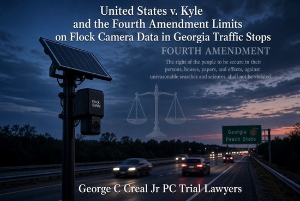 On October 1, 2026, U.S. District Judge Sara E. Hill of the Northern District of Oklahoma issued a significant order in United States v. Kyle, No. 26-CR-00189-SEH. The court suppressed all evidence seized after a deputy queried automated license plate reader (ALPR) databases, including Flock Safety’s network, without a warrant. The ruling is one of the first federal decisions to treat a historical Flock/ALPR query as a Fourth Amendment search when it reveals an extensive record of a driver’s movements.
A Tulsa County deputy (also a DEA task force officer) saw a Mazda SUV with California plates on an Oklahoma highway. According to the court, he followed the vehicle “for no apparent reason other than the fact that it had a California license plate.” While following it, he ran the plate through Flock and another ALPR system (VehicleManager). The query returned more than 50 historical sightings of the vehicle across multiple states over roughly a month.
The deputy later stopped the driver (Melisa Kyle) for a traffic violation, questioned her about her travel, and, after she refused consent to search, used a K-9. Officers found approximately 91 pounds of methamphetamine. Judge Hill suppressed the evidence on two independent grounds: (1) the stop was unlawfully prolonged after its original purpose ended without reasonable suspicion, and (2) the warrantless ALPR query itself was a Fourth Amendment search that required probable cause. Because the query had a clear nexus to the rest of the encounter, everything that followed was fruit of the poisonous tree.
Most courts that have addressed ALPRs have held that photographing license plates on public roads and querying the resulting database is not a search, relying on United States v. Knotts, 460 U.S. 276 (1983). Knotts held that a person has no reasonable expectation of privacy in movements on public thoroughfares that are visible to anyone. Judge Hill distinguished that precedent. She noted Knotts itself warned that “dragnet type law enforcement practices” might require different constitutional principles. She also looked at Carpenter v. United States, 585 U.S. 296, 138 S.Ct.2206,2210 (2018) (historical cell-site location information) and related reasoning about the “whole of a person’s physical movements.” A single query that instantly yields dozens of location points across states over a month, the court concluded, invades a reasonable expectation of privacy in the aggregate of a driver’s movements—even if each individual observation occurred in public.
The opinion is careful to note its limits: neither the Supreme Court nor the Tenth Circuit has decided the ALPR question, nearly every prior court has reached the opposite conclusion, and a district-court order binds only the parties before it. Flock and the government are expected to contest the ruling on appeal.
Georgia has one of the densest networks of Flock and other ALPR cameras in the country. Crowdsourced mapping projects document thousands of units statewide (with particularly heavy concentrations in metro Atlanta, along interstates, and in counties such as DeKalb, Fulton, Cobb, and Gwinnett). Local agencies, including Atlanta and DeKalb, have expanded or audited their use of the technology.
In a Georgia traffic stop or DUI investigation, officers can (and frequently do) query Flock or similar systems. If an officer runs a plate solely because it is out-of-state, because of a hunch, or on the basis of information that does not amount to reasonable suspicion or probable cause, and the query returns a detailed historical travel record, Kyle supplies a ready-made argument that the query itself is a warrantless search. Evidence developed after that query—admissions during the stop, a K-9 alert, or a vehicle search—may be suppressible as fruit of the poisonous tree if a court accepts the Kyle reasoning.
Georgia courts and the Eleventh Circuit have not yet squarely addressed this precise issue. Traditional Georgia and federal traffic-stop law still requires that any extension of a stop beyond its original purpose be supported by reasonable suspicion, and that vehicle searches generally require probable cause or a recognized exception. A Kyle-style argument would layer an additional challenge onto those familiar doctrines: that the ALPR database query independently violates the Fourth Amendment when it discloses the “whole of” a driver’s movements without a warrant.
United States v. Kyle does not outlaw Flock cameras or every plate check. It does, however, illustrate that the scale and retrospective nature of modern ALPR networks can push a routine database lookup across the constitutional line drawn in Carpenter. In a state with heavy Flock deployment, the decision gives Georgia defense lawyers a concrete, recent authority to cite when challenging stops and searches that begin with an unsupported plate-reader query.
If you or a loved one has been stopped and officers relied on Flock or other license-plate reader data, the facts of your case matter. An experienced Georgia DUI and criminal defense attorney can review the reports, video, and discovery to determine whether a suppression motion is viable.
www.georgialawyer.com
(770) 961-5511
Serving the entire State of Georgia.

George Creal is a trial lawyer who has been practicing law
in the Metro-Atlanta area for over 27 years. George brings
a broad range of experience to the courtroom. Read More