
Call Now For A Case Evaluation
Call Now For A Case Evaluation
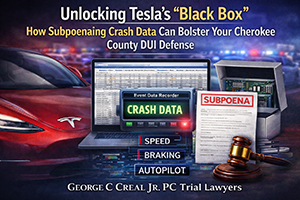 As a seasoned Cherokee County DUI lawyer with over 31 years of experience defending clients in Georgia’s courts, I’ve seen technology reshape how we approach DUI cases. In Cherokee County—where roads like Highway 92 and I-575 see their share of traffic stops and accidents—electric vehicles like Teslas are increasingly common. But what many drivers don’t realize is that your Tesla could be your best witness in a DUI investigation. Tesla vehicles log extensive data during crashes or safety events, and with a properly issued subpoena, this information can be game-changing. Whether it’s proving Autopilot engagement, challenging officer observations, or demonstrating safe driving behaviors, subpoenaing Tesla data has helped dismiss or reduce charges in numerous cases. Let’s dive into how this works and why it’s crucial for your defense.
Tesla’s advanced systems act like a digital flight recorder, capturing a wealth of information before, during, and after an incident. This includes the Event Data Recorder (EDR), cameras, sensors, and telemetry logs. According to Tesla’s privacy policy, they collect data on vehicle speed, acceleration, braking, steering, seatbelt usage, airbag deployment, battery status, software version, and even short video clips (up to 30 seconds) from external and cabin cameras during safety events like collisions or emergency braking. Location data, Autopilot or Full Self-Driving (FSD) status, driver attentiveness (via cabin monitoring), and system alerts are also logged, often triggered automatically by events such as airbag deployment or erratic driving detection.
In DUI contexts, this data is gold. For instance, if you’re accused of impaired driving based on “erratic” behavior, Tesla logs might show Autopilot was active and handling navigation flawlessly—potentially shifting blame from impairment to a software glitch or external factor. Recent NHTSA investigations into nearly 2.9 million Tesla vehicles highlight issues with FSD leading to traffic violations, including crashes in low visibility, which could support arguments that the vehicle, not the driver, contributed to the incident. Tesla doesn’t store all data indefinitely or link it to your identity by default, but crash-triggered data is preserved and can be accessed via legal channels.
Tesla emphasizes privacy and encrypts much of this data, but they comply with valid subpoenas, court orders, or law enforcement requests as required by law. In Georgia, including Cherokee County, we can subpoena this information in criminal or civil proceedings. The process typically involves:
For local cases, this data often reveals discrepancies in police reports. In a 2025 Fort Myers DUI incident, subpoenaed logs showed a Tesla safely pulling over after detecting driver unresponsiveness. In Cherokee County, where DUI arrests often hinge on subjective field tests, objective Tesla data can refute claims of weaving or speeding.
In Georgia DUI law (O.C.G.A. § 40-6-391), prosecutors must prove impairment beyond a reasonable doubt. Tesla data can dismantle their case by:
Recent trials, like the delayed 2025 Florida case over discovery disputes, underscore the importance of aggressive subpoena strategies. In Cherokee County courts, this evidence could lead to suppressed tests, plea reductions, and acquittals.
In an era where Teslas are everywhere on Cherokee County roads, ignoring subpoenaable crash data is a missed opportunity. As your DUI lawyer, I’ll ensure every byte works for you—whether fighting a wrongful arrest or negotiating with prosecutors. With ongoing scrutiny from NHTSA and courts holding Tesla accountable, 2026 is a pivotal year for these defenses.
If you’ve been in a Tesla-related crash or face DUI charges in Cherokee County, contact George Creal today for a free consultation. With my track record of more than 10,000 successful DUI cases, we’ll unlock the evidence you need to protect your future. Call now—your defense starts here!

George Creal is a trial lawyer who has been practicing law
in the Metro-Atlanta area for over 27 years. George brings
a broad range of experience to the courtroom. Read More