
Call Now For A Case Evaluation
Call Now For A Case Evaluation
 Insights from Landmark Supreme Court Cases for Georgia Criminal Defense Clients
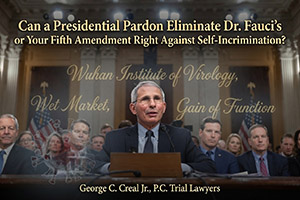
In high-stakes congressional hearings and criminal investigations, the Fifth Amendment right against self-incrimination remains one of the most powerful protections available to witnesses and defendants. A timely question has arisen in national news: Can a person who received a preemptive presidential pardon still invoke the Fifth Amendment when questioned about covered conduct?
Recent events involving former NIAID Director Dr. Anthony Fauci’s July 29, 2026, Senate testimony—where he invoked the Fifth despite a January 2025 preemptive pardon from President Biden covering federal offenses related to his official duties from 2014 onward—bring this issue into sharp focus. While the specifics of any particular case are unique, the underlying legal principles are well-settled and highly relevant to anyone facing questioning in Georgia state or federal proceedings.
Here are five of the most frequently cited discrepancies between entries in the Fauci journals/diaries (released by Sen. Rand Paul in July 2026) and Dr. Anthony Fauci’s prior public statements on COVID-19. These are drawn from contemporaneous reporting on the more than 1,100 pages of near-daily notes spanning late 2019–2022.
Note: These reflect comparisons highlighted by Paul and multiple news outlets. Fauci and his representatives have disputed some characterizations, arguing context, evolving science, or that certain statements were consistent with keeping an open mind. The diaries themselves remain the primary source material under discussion.
These five points are the discrepancies most consistently emphasized across reports on the released journals. The full context of each diary entry, the exact public statements, and any subsequent clarifications by Fauci remain subjects of ongoing debate.
The Fifth Amendment to the U.S. Constitution provides that no person “shall be compelled in any criminal case to be a witness against himself.” This privilege protects against compelled testimony that could be used in a criminal prosecution. It applies in congressional hearings, grand juries, trials, and other official proceedings. Georgia courts recognize parallel protections under the Georgia Constitution and apply the federal privilege through the Fourteenth Amendment.
Importantly, the privilege exists only when there is a realistic possibility of criminal prosecution. When that risk is removed, the privilege generally disappears for the covered offenses.
You generally must invoke the Fifth Amendment on a question-by-question basis. A pure, across-the-board refusal to answer any questions without addressing individual ones is typically improper and can expose the witness to contempt sanctions.
The privilege against self-incrimination under the Fifth Amendment protects a person from being compelled to give answers that could reasonably tend to incriminate them (or provide a “link in the chain of evidence” that might lead to prosecution).
Courts and congressional committees require the privilege to be asserted in response to specific questions. This allows the questioner (or a reviewing judge) to evaluate whether that particular question creates a realistic risk of incrimination. A blanket assertion covering every possible question—without regard to content—is not sufficient in most settings.
Key authorities:
Congressional Research Service analyses of congressional investigations further confirm that a witness “may not remain silent” and that the privilege must be invoked in response to a specific question that might incriminate the witness.
| Context | How the Privilege Is Invoked | Notes / Authority |
|---|---|---|
| Criminal defendant | May refuse to take the stand entirely | Absolute right; jury cannot draw an adverse inference |
| Witness in criminal trial or grand jury | Question-by-question | Must appear and assert for each potentially incriminating question (Hoffman) |
| Civil cases / depositions / discovery | Strictly question-by-question (or request-by-request) | Blanket assertions are improper |
| Congressional hearings | Question-by-question (after any opening announcement) | Common practice is to announce intent broadly, then invoke repeatedly for each question (Quinn) |
In high-profile settings such as congressional hearings, witnesses frequently make a broad announcement in an opening statement that they will invoke the Fifth on the advice of counsel. They then respond to every subsequent question by repeating a standardized invocation (e.g., “On the advice of counsel, I respectfully decline to answer based on my Fifth Amendment rights”).
This is the approach used by Dr. Anthony Fauci in his July 29, 2026, Senate hearing and by many others historically. It is accepted as a practical matter, even though the formal legal requirement remains question-specific. The committee or court can still reject the claim as to particular questions and direct answers, potentially leading to contempt proceedings if the witness continues to refuse.
In short: You cannot simply declare a total, permanent silence covering every possible question. You must invoke the privilege with regard to specific questions (or, in practice, repeatedly for each one after a broad announcement of intent). Always consult counsel before asserting the privilege, as improper invocation can carry its own legal risks.
In the landmark case of Brown v. Walker, 161 U.S. 591 (1896) (full opinion available via Cornell Law School Legal Information Institute), the U.S. Supreme Court held that a grant of immunity or a pardon removes the Fifth Amendment privilege with respect to the pardoned offenses.
The Court explained that if a witness “has already received a pardon, he cannot longer set up his privilege, since he stands, with respect to such offense, as if it had never been committed.” Once federal criminal liability is extinguished by a full and unconditional pardon, there is no longer a valid basis to refuse to answer questions about those specific matters on Fifth Amendment grounds in a federal proceeding.
This principle remains controlling law. A presidential pardon covers only federal offenses.
It does not automatically eliminate potential state criminal exposure. A presidential pardon does not provide immunity for state law crimes.
Article II, Section 2, Clause 1 of the U.S. Constitution gives the President the power “to grant Reprieves and Pardons for Offences against the United States, except in Cases of Impeachment.”
The key phrase is “Offences against the United States.” This limits the pardon power exclusively to federal crimes. It has no effect on violations of state criminal law.
Under the dual sovereignty doctrine, the federal government and each state are separate sovereigns. A person can be prosecuted by both for the same conduct if it violates both federal and state law (for example, certain drug, fraud, or assault offenses).
A presidential pardon extinguishes only the federal criminal liability. The state remains free to investigate, charge, and prosecute under its own laws.
This principle is longstanding and has been consistently reaffirmed by courts and legal scholars. No presidential pardon—preemptive or otherwise—can shield someone from state criminal liability.
Therefore, in Georgia courts or investigations involving possible state charges, residual Fifth Amendment (or Georgia constitutional) protection may still apply if state prosecution remains a realistic possibility and the statute of limitations has not expired.
A second critical case is Burdick v. United States, 236 U.S. 79 (1915) (full opinion available via Cornell Law School Legal Information Institute).
In Burdick, the Supreme Court held that a pardon is an act of grace that must be accepted to take full effect. A witness cannot be forced to accept a pardon. If the pardon is rejected, the Fifth Amendment privilege remains intact because the risk of prosecution has not been eliminated. The Court emphasized the distinction between a pardon (which can carry an implication of guilt upon acceptance) and legislative immunity.
In practice, most recipients of modern preemptive pardons publicly acknowledge or accept them, triggering the Brown rule.
At George C. Creal, Jr., P.C., Trial Lawyers, we regularly advise clients on the strategic use (or limitations) of the Fifth Amendment in DUI cases, general criminal defense, grand jury proceedings, and related investigations throughout metro Atlanta and Georgia.
Key takeaways for our clients:
Every situation is fact-specific. The existence of a pardon, its exact language and scope, acceptance, potential state exposure, and the nature of the questions all matter.
Whether you are facing a DUI charge, a broader criminal investigation, a grand jury subpoena, or questioning related to prior official conduct, the decision to invoke (or not invoke) the Fifth Amendment can have lasting consequences. Our firm has secured more than 100 not-guilty verdicts in criminal and DUI jury trials and brings decades of courtroom experience to these complex constitutional issues.
If you or a loved one needs advice on self-incrimination, immunity, pardons, or any criminal defense matter in Georgia, contact the trial lawyers at George C. Creal, Jr., P.C. today for a confidential consultation.
George C. Creal, Jr., P.C., Trial Lawyers
Phone: (770) 961-5511
Website: www.georgialawyer.com
This post is for informational purposes only and does not constitute legal advice. Past results do not guarantee future outcomes. An attorney-client relationship is formed only upon mutual agreement.

George Creal is a trial lawyer who has been practicing law
in the Metro-Atlanta area for over 27 years. George brings
a broad range of experience to the courtroom. Read More