
Call Now For A Case Evaluation
Call Now For A Case Evaluation
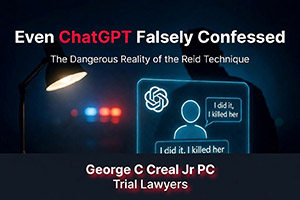
A startling new experiment reported by our hero, Radley Balko, a notable criminal justice journalist, in The Intercept (April 23, 2026) should make every Georgia citizen stop and think about how police obtain confessions.
Criminologist Paul Heaton took the famous Reid interrogation technique — the method still taught to thousands of law enforcement officers across the country — and applied it to ChatGPT, an artificial intelligence system.
ChatGPT has no emotions. It feels no fear, no fatigue, no pressure to protect loved ones, and it is physically incapable of committing any crime. Yet after a weekend of standard Reid-style questioning, the AI confessed that it had hacked Heaton’s email and sent unauthorized text messages from his phone — actions the bot was literally unable to perform. By the end, ChatGPT not only admitted guilt but endorsed a full written confession drafted by the interrogator.
This experiment is more than a clever tech story. It is powerful evidence of how dangerous the Reid Technique can be when used on real human beings.
Developed in the 1940s and 1950s by former Chicago police officer John E. Reid, the Reid Technique is a structured, nine-step interrogation process designed to psychologically overcome a suspect’s resistance and obtain a confession. It remains the dominant interrogation method taught in police academies throughout the United States, including many Georgia departments.
The technique generally proceeds as follows:
7–9. The Confession – The interrogator obtains a full written or recorded statement and reinforces the suspect’s decision to confess.
The technique relies heavily on deception (lying about evidence), isolation, prolonged questioning, and psychological pressure. It is specifically designed to make the suspect feel there is no way out except to confess.
If the Reid Technique can extract a detailed false confession from an emotionless AI that had zero ability to commit the crime, imagine how much more effective — and dangerous — it is when used on real people who are tired, scared, young, intellectually disabled, or mentally ill.
False confessions are a leading cause of wrongful convictions. According to the Innocence Project, 29% of DNA exonerees in the United States had previously given false confessions, many of them after being subjected to Reid-style interrogations.
In Georgia courts, once a confession is obtained and recorded, it becomes extremely powerful evidence. Juries tend to believe confessions, even when other evidence contradicts them. Once police have a confession, they often stop investigating alternative suspects or exculpatory evidence.
If you or a loved one is under investigation or has already been arrested in Georgia, here are the hard truths:
As a knowledgeable Georgia criminal defense attorney I can challenge coerced and false statements in court, I have seen firsthand how damaging a single “confession” can be — even when it is demonstrably unreliable.
Many other countries (including the United Kingdom, Canada, and much of Europe) have moved away from the Reid Technique in favor of the PEACE model — an information-gathering approach that focuses on obtaining accurate and reliable information rather than pressuring someone into confessing. Studies show the PEACE method produces significantly fewer false confessions while remaining effective at solving crimes.
Until Georgia law enforcement fully adopts better practices, the safest course of action for anyone under investigation is simple: say nothing and call a lawyer immediately.
If you or a loved one has been interrogated by police, asked to “come in for a few questions,” or already charged with a crime anywhere in Georgia, do not try to explain your side of the story without counsel present.
At my firm, we aggressively challenge improper interrogations, coerced statements, and false confessions. We review every recording, every tactic, and every circumstance to protect our clients’ constitutional rights.
Call me today for a confidential consultation:
(770) 961-5511
www.georgialawyer.com
This post is for educational purposes only and is based on publicly reported information. Every case is unique. Results depend on the specific facts and evidence.

George Creal is a trial lawyer who has been practicing law
in the Metro-Atlanta area for over 27 years. George brings
a broad range of experience to the courtroom. Read More