
Call Now For A Case Evaluation
Call Now For A Case Evaluation
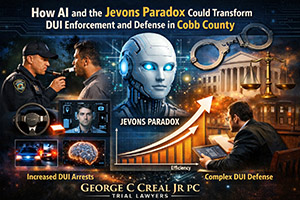 As a seasoned DUI lawyer serving Cobb County and the greater Atlanta area for over 31 years, I’ve seen firsthand how technology shapes the landscape of drunk driving cases. From breathalyzers to dash cams, advancements have always played a pivotal role in both prosecution and defense. Today, we’re on the cusp of a new era with artificial intelligence (AI) entering the fray. But what happens when we pair AI’s efficiency with the economic principle known as the Jevons Paradox? In this post, I’ll explore how these forces might impact DUI incidents and defense strategies, drawing on emerging trends in technology and law enforcement.
AI is already making waves in efforts to curb impaired driving. Law enforcement and automakers are integrating sophisticated systems that go beyond traditional field sobriety tests or chemical breath tests. For instance, technologies like the Driver Alcohol Detection System for Safety (DADSS) use sensors embedded in steering wheels to measure a driver’s blood alcohol content through their breath or skin. Other innovations include AI-powered cameras and mobile apps that analyze facial cues, eye movements, speech patterns, and even cognitive distractions to detect impairment from alcohol or drugs.
In-vehicle systems are particularly promising—or concerning, depending on your perspective. Multi-signal fusion technology combines data from various sensors to identify alcohol-impaired driving with high accuracy, potentially preventing drivers from starting their vehicles altogether. Facial recognition algorithms can swiftly flag impairment, and we’re seeing prototypes like the Driver NeuroMonitoring System that monitor brain activity for signs of distraction or intoxication. These tools aim to make roads safer by intervening before an accident occurs, but they also raise questions about privacy, accuracy, and overreach in Cobb County’s traffic stops.
On the enforcement side, AI could automate DUI detection through predictive analytics, analyzing patterns in driving behavior via connected vehicles or roadside cameras. This shift promises to make policing more efficient, catching more impaired drivers with fewer resources.
To grasp the full implications, let’s dive into the Jevons Paradox, a concept from 19th-century economist William Stanley Jevons. He observed that improvements in the efficiency of steam engines didn’t reduce coal consumption—in fact, it increased it. Why? Because cheaper, more efficient technology made coal-powered operations more accessible and profitable, leading to widespread adoption and higher overall use.
This paradox appears in modern technology too. For example, energy-efficient LED lights have led to more lighting usage overall, not less energy consumption. In AI itself, advancements in computational efficiency haven’t curbed energy demands; instead, they’ve fueled explosive growth in data centers and resource-intensive applications. The key takeaway: Efficiency doesn’t always save resources—it often amplifies consumption by lowering barriers and encouraging more activity.
Now, imagine applying this to DUI enforcement. If AI makes detecting impaired drivers cheaper and more efficient, law enforcement agencies in Cobb County and beyond might ramp up their efforts. Instead of sporadic checkpoints or reactive patrols, AI could enable constant, widespread monitoring through smart infrastructure or vehicle telematics. This efficiency could lead to more DUI arrests, not fewer, as agencies allocate saved resources to broader surveillance.
Paradoxically, this might not reduce drunk driving incidents. Drivers could become over-reliant on AI safety nets, supervised autonomy, and in-vehicle prevention systems, leading to riskier behaviors—similar to how efficient cars encourage longer drives, boosting overall fuel use. If people perceive roads as safer due to AI, they might drink more or drive under the influence more often, offsetting the tech’s benefits. We’ve seen echoes of this in other areas: Efficient over-consumption in energy leads to higher pollution, and in DUI, it could mean a surge in cases despite better detection.
From a societal view, this could strain the legal system. More arrests mean more court cases, potentially overwhelming prosecutors and defenders alike. But it also highlights a rebound effect: As AI lowers the cost of enforcement, society might “consume” more justice resources, perpetuating the cycle. However, unsupervised, Full Self-Driving might have the opposite effect.
For defense attorneys like myself, AI introduces both opportunities and challenges. On the positive side, AI tools can supercharge investigations. We can use predictive analytics to forecast case outcomes based on historical data, analyze vast amounts of evidence like body cam footage or sensor logs, and identify inconsistencies in prosecution claims. This levels the playing field, allowing us to challenge faulty AI detections by demanding details on algorithms, training data, and error rates—grounds for suppression motions if the tech proves unreliable.
However, the Jevons Paradox could amplify defenses too. As AI floods the system with more cases, defense strategies might evolve to exploit the tech’s efficiencies, like automating challenges to mass-produced evidence. But beware: AI isn’t a substitute for experienced counsel. It can’t negotiate pleas, argue in court, or navigate the nuances of Georgia’s DUI laws. Relying solely on AI for advice could backfire, leading to poor outcomes.
In Cobb County, where DUI enforcement is rigorous, these changes mean defendants must be vigilant. AI evidence in court will require skilled cross-examination to expose biases or inaccuracies, turning the paradox into a defense advantage.
AI combined with the Jevons Paradox suggests a future where DUI enforcement becomes more pervasive, potentially increasing arrests while complicating defenses. Yet, this also opens doors for innovative legal strategies that protect your rights. As technology evolves, staying informed is key.
If you’re facing a DUI charge in Cobb County, don’t leave your defense to chance—or to AI alone. Contact me, George Creal, for a free consultation. With my track record of over 1,000 successful DUI defenses, I’ll fight to ensure technology works for you, not against you. Visit my website or call today—your future depends on it.
For more information about DUI defense in Cobb County, visit our Experienced Cobb County DUI Lawyers page.

George Creal is a trial lawyer who has been practicing law
in the Metro-Atlanta area for over 27 years. George brings
a broad range of experience to the courtroom. Read More