
Call Now For A Case Evaluation
Call Now For A Case Evaluation
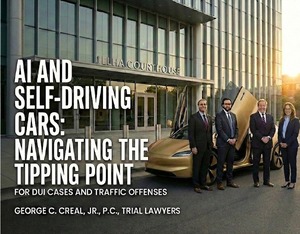 As Georgia’s premier DUI defense firm, George C. Creal Jr., PC Trial Lawyers has spent decades fighting for clients facing life-altering charges. In an era where technology is reshaping every aspect of our lives, we’re keeping a close eye on how AI and self-driving cars—also known as autonomous vehicles (AVs)—could transform the landscape of DUI cases and traffic offenses. Drawing on Malcolm Gladwell’s tipping point framework from his seminal book, we explore this not as a crystal ball for predictions, but as a tool for interpretation. Tipping points emerge when incremental changes build up quietly, often dismissed as underwhelming, until they trigger a dramatic, qualitative shift. Think of how smartphones went from clunky novelties to indispensable tools almost overnight. Similarly, AVs might follow this path, slowly accumulating advancements before upending road safety, liability, and legal norms.
Gladwell’s concept describes how small, marginal improvements can compound until they cross a threshold, leading to rapid, epidemic-like adoption. In technology, these shifts are rarely spotted in real time—observers often view progress as “disappointing” right up until the moment it’s revolutionary. Applied to AVs, this means years of incremental tech tweaks, regulatory hurdles, and pilot programs could suddenly culminate in widespread use, altering how we handle everything from drunk driving to speeding tickets. Gladwell himself has skeptically analyzed self-driving cars, arguing they might fail in chaotic urban environments due to human unpredictability, like pedestrians exploiting overly cautious AI. Yet, this skepticism underscores the framework: progress feels inconsequential until it isn’t.
As a DUI attorney starting out in the late 1990s, I personally experienced this tipping point phenomenon with the rise of the internet. Back then, I mistakenly assumed that online advertising for lawyers would never catch on—it seemed like a gimmick compared to the tried-and-true Yellow Pages, where everyone looked for services. I stuck with those bulky phone books, pouring resources into print ads, convinced the web was just a passing fad for tech enthusiasts. But as search engines like Google gained traction and people shifted to digital directories, the accumulation of small changes—faster internet speeds, more user-friendly websites, and growing online habits—hit a threshold. Suddenly, the Yellow Pages were dead, gathering dust, while the World Wide Web became quite literally everything for client outreach. It was a humbling lesson in retrospect: I had dismissed the “disappointing” early progress, only to scramble to catch up when the shift became undeniable. This mirrors what we might see with AVs today.
As of early 2026, AVs are advancing but haven’t tipped yet. Most consumer vehicles operate at SAE Level 2 (partial automation, like Tesla’s Autopilot, requiring constant driver attention) or Level 3 (conditional automation, where the car handles most tasks but humans must be ready to intervene). Full autonomy (Level 4 or 5, no human input needed) is limited to robotaxis in select cities. Waymo, for instance, has expanded to Las Vegas and San Francisco, logging over 100 million autonomous miles, with plans for more cities in 2026. Tesla aims to dominate with its fleet, while companies like Zoox and Ford push AI upgrades for 2026-2027 launches.
Progress has been “disappointing” in Gladwell’s sense: timelines for full rollout have slipped by 1-2 years since last estimates, with global Level 4 adoption now eyed for 2030-2032 due to technical, regulatory, and economic barriers. In Georgia, AV testing is underway, but widespread consumer access remains limited. Federal pushes for national standards in 2026 could accelerate this, addressing the patchwork of state laws stifling innovation. These marginal gains—better sensors, AI reasoning, and scaled production—are building quietly.
DUI laws in Georgia, like most states, focus on “operating” a vehicle with a BAC over 0.08. But AVs blur this: if the car drives itself, is the occupant “operating” it? Currently, no—laws haven’t caught up, and courts hold humans accountable if they’re in the driver’s seat or have “actual physical control.” Past cases, like Tesla drivers arrested for DUI while on Autopilot, show that semi-autonomous features don’t absolve responsibility.
A tipping point could reduce traditional DUIs by eliminating human error, which causes 94% of crashes. AVs might cut alcohol-related fatalities (28% of U.S. traffic deaths) by allowing safe transport for intoxicated individuals. However, this shift might increase overall alcohol consumption, as people feel safer using AVs after drinking. New challenges emerge: liability for AI malfunctions (e.g., manufacturer fault in crashes), or DUIs if software updates aren’t maintained. In Georgia, where DUIs can lead to license suspension, fines, and jail, AVs could shift cases from driver impairment to product liability or cyber issues.
Beyond DUIs, AVs could revolutionize traffic enforcement. AI cameras already flag erratic driving for stops, raising Fourth Amendment concerns about algorithmic probable cause. Post-tip, offenses like speeding or reckless driving might decline as AVs adhere strictly to laws, but new violations could arise—e.g., hacking AV systems or failing to override in emergencies. Liability might pivot to manufacturers for “defective” AI, complicating cases involving mixed human-AV traffic.
In Georgia, where traffic tickets fund local budgets, fewer human errors could mean revenue drops, prompting new regulations. Yet, safer roads (AVs already show fewer accidents per mile) align with public policy goals.
Using Gladwell’s lens, we’re not predicting AVs will eliminate DUIs tomorrow—that would ignore the “disappointing” phase we’re in. Instead, interpret the accumulation: 2026 sees federal standards, expanded robotaxis, and AI breakthroughs. When the tip comes, it could qualitatively shift legal battles from breathalyzers to black-box data analysis. For now, drivers must remain vigilant—AVs don’t yet offer a free pass.
At George C. Creal Jr., PC, we’re prepared for whatever shifts occur. If you’re facing DUI or traffic charges in Georgia, contact us today for aggressive, informed defense. Technology changes, but your rights don’t.

George Creal is a trial lawyer who has been practicing law
in the Metro-Atlanta area for over 27 years. George brings
a broad range of experience to the courtroom. Read More